The DevOps Evolution: Platform Engineering and Its Role in 2025

Software development and operations are constantly changing landscapes, driven by the pursuit of efficiency and speed.

In the last decade, DevOps has been the centre of a transformative movement.

In this, they have broken down walls between development and operations and were able to foster collaboration that can automate the software delivery cycle, a feat of its own.

However, that is not enough in today’s time.

Organisations are navigating a much complex cloud-native structure and microservices, and they demand better developer productivity.

This births a new paradigm that is now taking on the space known as Platform Engineering.

Platform Engineering is the next step in DevOps as it offers a structural approach to the underlying complexities of today’s modern software delivery.

This is far from just being a buzzword.

In this article, we will look into the evolution from DevOps to Platform Engineering and will understand what role Platform Engineering plays in today’s organizations and their dynamic field.
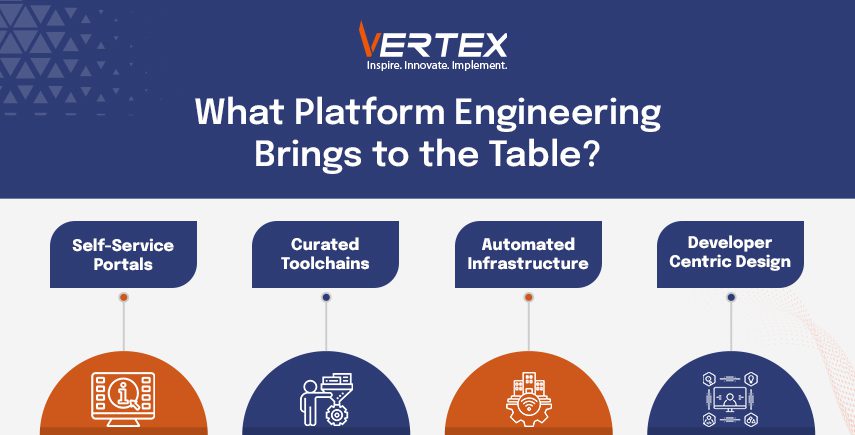
Infographic on platform engineering: self-service portals, curated toolchains, automated infra, developer centric design.

The Evolution from DevOps to Platform Engineering

DepOps core unifies development and operations for faster and more reliable software releases.

Cultural integration and continuous delivery, being the two pillars of DevOps, have been able to provide significant improvements in the past decade.

However, the modern world is moving too fast for DevOps to catch up.

Complex modern IT environments demand more than DevOps can handle; for example, implementing and scaling DevOps across a large, diverse team is challenging because we can now expect every developer to possess deep expertise, and the infrastructure becomes unrealistic, which results in delays and certain bottlenecks. 

Platform Engineering is the answer to all the scalability challenges, as it is built upon the core principles of DevOps but with its own layer of abstraction and standardization.

The major difference between DevOps and Platform Engineering is that in Platform Engineering, we do not focus on individual teams and their sets of tools or infrastructure.

Instead, we focus on building self-service capabilities, curated toolchains, and automated infrastructure that simplify the underlying complexity for developers.

In simpler ways, Platform Engineering aims to treat internal developers as customers and to productize the infrastructure and operational tooling.

With this shift, development teams can focus on building a business without worrying about the issues of infrastructure management.

The change from DevOps to Platform engineering is crucial for a well-established, structured, scalable, and developer-centric approach to software delivery.
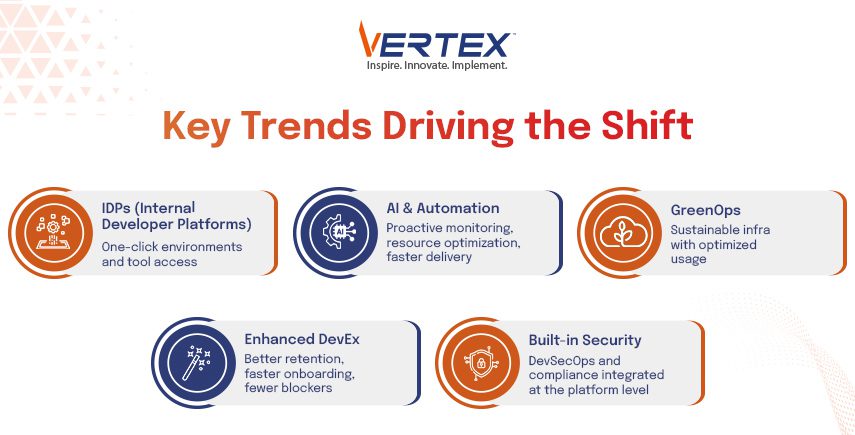
Infographic on trends: IDPs, AI & Automation, GreenOps, Enhanced DevEx, Built-in Security with DevSecOps.

Key Trends Driving the Evolution

The trends that are fueling the Evolution of DevOps to Platform Engineering are mentioned below.

Infrastructure complexities and Cloud-Native Structures: 

The frequent adoption of cloud-native technologies, such as Docker and orchestration platforms like Kubernetes, along with microservices, has made working with these technologies complex.

Managing these distributed environments and then delivering the desired results requires specialized skills and tools.

Platform Engineering has the required means through which we can overcome these complexities and help developers by offering them a simplified interface to work and interact with such powerful technologies. 

The Need for Enhanced Developer Experience (DevEx): 

In today’s time, retaining a talented developer is crucial; a poor developer can bring in a lot of friction and will cause an overload of work, resulting in decreased productivity and dissatisfaction from the stakeholders.

Platform Engineering directly addresses this by providing self-service tools and automated workflows, along with improving DevEx. 

DevOps Practices: 

When an organisation grows, they have to revisit the implementation of DevOps through the new teams, and this poses a challenge.

However, this is not the case with Platform Engineering; you get a centralized approach with Platform Engineering, and it ensures consistency and best practices for each and every organization.  

Enhancing (DevSecOps): 

We have to periodically enhance the security of software during its development cycle.

Platform Engineering plays a vital role in implementing security controls in the infrastructure and platforms, ensuring that the development cycle remains unharmed. 

Everything (IDPs): 

IDPs, or Internal Developer Platform, is a core component of Platform Engineering.

They are used to provide a self-service portal for the developers so that they can use the necessary infrastructure tools.

This reduces the reliance on the operations team for routine tasks, speeds up development cycles, and promises a better developer anatomy. 

Artificial Intelligence (AI) and Automation: 

Incorporating AI into platforms can automate many tasks, such as infrastructure provisioning, resource allocation, anomaly detection, and incident response.

This will further increase efficiency and reduce manual effort for platform teams. 

Infrastructure as Code and GitOps: 

Managing code through GitOps provides transparency, control of versions, and automation.

These are helpful in creating a reliable platform with fewer vulnerabilities. 

The Role of Platform Engineering in 2025

Platform Engineering in 2025 is going to play a vital role in the development of several industries and organizations, and we have listed some of them for you below:

Simplifying Complexity: 

Developers face a major obstacle in the complexity of cloud-native environments.

Overcoming this hurdle is crucial for better efficiency.

Now, Platform Engineering does this by providing developers with a friendly and consistent experience.

This enables them to focus on writing code and delivering features without ever needing deep infrastructure expertise. 

Enhancing Developer Productivity: 

Platform Engineering offers self-service capabilities, along with automated workflows and curated toolchains.

This lightens the developers’ workloads and makes them more efficient and productive. 

Improving Operational Efficiency: 

If there are repetitive tasks, Platform Engineering will automate them.

This is simple math, and it saves us resources and time and ensures the reliability and scalability of the underlying infrastructure.

This leads to improved operational efficiency.

Strengthening Security and Compliance: 

Platform Engineering can help organisations effectively when they have already embedded security controls and compliance policies into their platform.

This will make the onboarding of DevSecOps practices smoother and with fewer vulnerabilities, ensuring compliance with regulatory requirements. 

Enabling Faster Time-to-Market: 

After Platform Engineering, the self-service nature of the internal developer and the automation provided help smooth the process of software delivery, enabling organisations to respond more quickly to market demands. 

Fostering Collaboration: 

Platform Engineering provides a centralized foundation that fosters collaboration between the development and operations teams.

Thus, it provides a common platform and shared understanding of the infrastructure. 

Optimizing Costs: 

Platform Engineering promotes infrastructure management and resource utilization to the full extent.

This helps in optimizing the cloud and infrastructure costs for the organisation. 

Platform Engineering Best Practices

Organisations should comply with these best practices to implement and benefit from Platform Engineering. 

  • Treat the Platform as a Product: The best practice any organisation can adopt is to treat its internal developers as customers. It should listen to and understand their needs and gather as much feedback as it can. Then, based on the feedback, it should define a clear plan of action that will help the developers reach their goal. 
  • Focus on Developer Experience: They should prioritize the developer and the experience and ensure self-service portals, clear documentation, and optimized workflows. This will help minimize the load and maximize the developer’s satisfaction. 
  • Build Self-Service Capabilities: If the developers are provided with self-service tools and infrastructure, then they will not have to rely on the operations teams, and this will accelerate workflows. 
  • Automate Everything Possible: Try automating all the repetitive tasks, infrastructure provisioning, deployments, and security checks. Automation is the answer for improving efficiency and reliability. 

The Future of DevOps and Platform Engineering

If we are to see and talk about the future of DevOps Platform Engineering, then it can be defined by the trends and key aspects mentioned below. 

Increased Adoption of AI and Autonomous Systems: 

AI incorporation will be over 50%, and there will be automated platform operations, predicting potential issues and optimizing resource utilization.

These systems will be self-enabled and become more prevalent with time.

IDPs will become more intelligent, offering personalized recommendations based on developers’ usage patterns. 

Greater Focus on Sustainability (GreenOps): 

Sustainable practices in platform engineering will include optimizing resources to the full extent and eliminating the infrastructure’s carbon footprint. 

Enhanced Security and Compliance Automation: 

Security will be a major concern, and to overcome this concern, AI-powered tools will be available that can detect any possible vulnerability and enforce policy and compliance management. 

The future of DevOps is intertwined with the evolution of Platform Engineering, as Platform Engineering provides a framework through which you can achieve your goal of DevOps scaling in environments.

Many say DevOps is being replaced by Platform Engineering.

Well, in my opinion, it is like phasing into an evolved stage of DevOps.

This stage is more focused on building a robust, scalable, and developed platform. 

Conclusion

2025 is the year in which Platform Engineering will come on top as the next step in the evolution of DevOps.

The structures and self-service platforms that reduce the complexities of the modern infrastructure empower developers, enhance their operational efficiency, and speed up software delivery. 

The future is AI, and its incorporation in IDPs will result in a better path for automation in Platform Engineering.

Platform Engineering is paving the path for better, more secure, and developer-friendly software delivery in the coming year.

Streamlining Business Processes: How to Integrate Power Automate with Your Existing Systems

Organizations now require smarter methods to lead the competition rather than traditional approaches of working harder.

Every business organization pursues methods to eliminate physical work while enhancing precision levels and production rates. Organizations like yours complete many similar businesses across the world.

Gartner estimates that 30% of organizations will deploy automation solutions in their business processes to achieve operational improvement by 2026.

The tool that leads this transformation is Microsoft Power Automate.

This blog will provide an approach to using Power Automate integration with existing systems, which transforms workflow execution through hands-on demonstrations and practical implementations.

What Is Power Automate?

Power Automate works as a digital assistant that automates different tasks for you.

The no-code/low-code Microsoft platform enables different apps and services to generate automated workflows.

The workflows powered by Power Automate execute recurring operations as well as data synchronization and instant alert notifications without requiring continuous human supervision.

And the best part? You do not require technical expertise to use Power Automate.

Microsoft’s Power Automate enables all users to create workflow implementations through its easy-to-use visual mapping system.

But why should you care about integrating it into your current systems?

Let’s dive in.

Why Integrate Power Automate with Your Business Systems?

Automation represents more than a hot trend because it has become essential for every organization to succeed in this modern business environment.

By integrating Power Automate, your organization will obtain the following advantages:

So, how do you get started?

Your first step requires evaluating locations where automation will generate the most improvement.

Where Should You Start? Assessing Your Automation Needs

Your first step should be to determine which areas would benefit most from automation.

Follow these procedures to start your work:

  1. Note down your process flow to find problems in your work.
  2. Seek tasks that repeat often with high error and slowdown rates.
  3. Establish your targets by stating what you want to achieve, which includes speeding up processing, decreasing errors, and enhancing customer feedback.

Once you know what to automate, it’s time to plan your integration strategy.

Planning a Successful Power Automate Integration

A basic preparation stage helps achieve better results.

These steps will help you achieve a successful Power Automate implementation:

  • Engage Stakeholders: Ask All Staff Members to Offer Their Employees’ Requirements and Create Support Amongst Teams
  • Allocate Resources: Determine how much time, money, and employees are needed to connect technologies successfully.
  • Identify Risks: Find upcoming challenges and develop solutions to deal with system compatibility issues beforehand.

Now that you’re equipped with a plan, let’s explore how to implement Power Automate step by step.


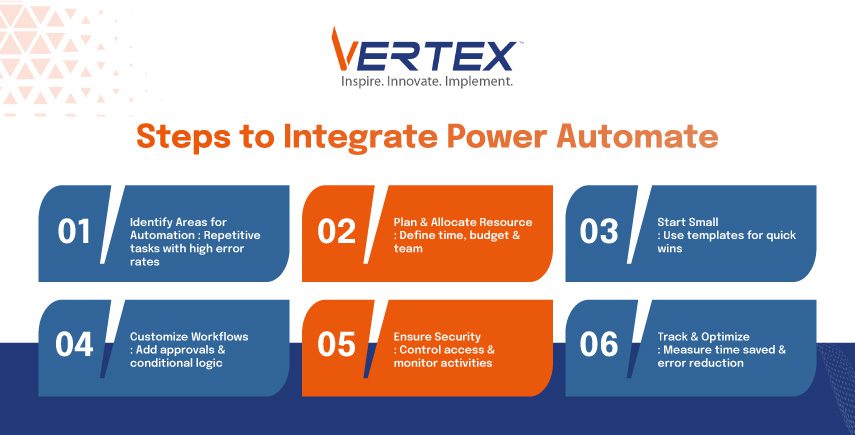
Infographic on integrating Power Automate: identify areas, plan resources, start small, customize, ensure security, track & optimize.

How to Integrate Power Automate with Your Systems

  1. Start Small: Begin with a pilot project. The simplest process to automate provides the best data to measure success.
  2. Use Templates: Microsoft provides numerous predefined templates in its library for you to start working with right away.
  3. Customize Your Workflows: Use conditional logic to direct processes and add approval rules to match your business operations.
  4. Prioritize Security: Secure all data by giving authorized employees access and by regularly checking system activity.
  5. Monitor and Optimize: Review operations regularly while looking at results to update your automation system.

Measuring the Success of Your Automation Efforts

Checking if your Power Automate integration operates correctly requires what actions?

Watch the following metrics to measure success:

  • Process Completion Time: How much faster are tasks completed? The automation system saves us time when tasks are completed.
  • Error Rates: Are you seeing fewer mistakes and inconsistencies? Your system produces fewer errors now than before the integration.
  • Employee Productivity: Are employees spending more time on strategic tasks? Members of staff focus more on leadership activities rather than daily operations.
  • Cost Savings: What operational expenses have decreased since implementing automation? Report all operational expenses that were reduced when you added automation features.

Tracking these metrics helps you fine-tune your automation strategy for maximum impact.

Addressing Common Integration Challenges

Like any major change, integrating Power Automate comes with its share of hurdles.

Here are some common challenges:

  • Data Complexity: Handling different types of data calls for special attention. You can make data movement smooth by connecting Power Automate to external systems.
  • User Adoption: Employees may refuse to accept new business system requirements. Provide personal training and show staff what Power Automate brings them.
  • System Compatibility: Your existing business systems could hinder automated workflows due to incompatibility concerns. Develop a connector platform to connect different systems.
  •  Security Concerns: When automating processes, security issues arise that threaten personal data integrity. A secure system environment needs proper access restrictions plus regular monitoring of workflow activities.


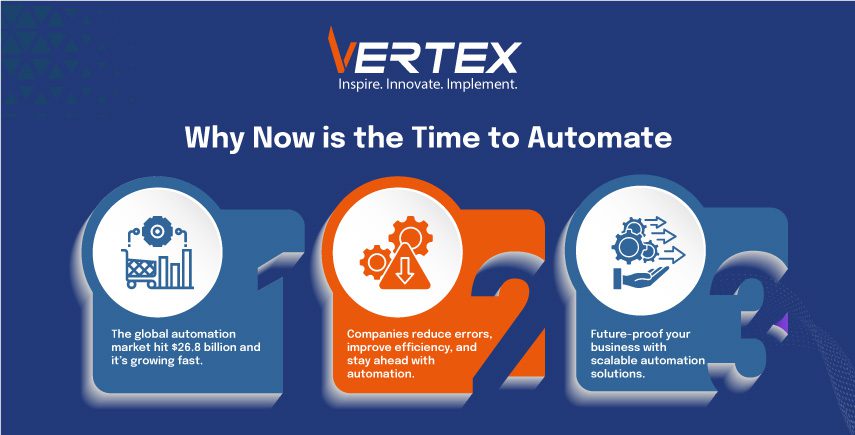
Infographic: Global automation market $26.8B growing fast, reduces errors, future-proofs with scalable automation.

Why Now Is the Time to Embrace Automation

AI and automated software solutions hit USD 26.8 billion in global markets, according to a report.

So, yes, it is going to spread, and when you start using Power Automate today, you will surely receive these benefits first:

  • Prove your business ahead of others while disabling mistakes within your workflow.
  • Deliver strong and unique customer experiences by responding faster to their needs.
  • Make your business adaptable by adding automation tools that can expand as your operations grow.

Wrapping Up

Using Power Automate as a company represents more than a wise decision because it serves as an essential strategy to maintain competitiveness within digital environments.

You can have advanced levels of operational efficiency and innovation.

Learn how VertexCS will direct your automation path and assist in business process optimization for current needs.

Enterprise IT Transformation with Microsoft

Application Integration for Digital Transformation

Application Integration is the process of enabling different digital applications – each developed for a specific purpose – to work with each other. When configured properly, integration allows distinct systems to seamlessly communicate.

In today’s world, Enterprise IT Transformation invariably includes leveraging the Cloud.  As organizations re-engineer their business processes, leveraging On-Premise systems and investments that are already in place and integrating them with new cloud-based solutions is key to cost-effectively stand up new capabilities and services.

Cloud-based app integration is pivotal in business process augmentation, involving various tools and technologies. With clear planning, app integration can reduce IT silos and improve connectivity to integrate applications that unify management, ease access, and limit manual intervention by utilizing various ready-to-plug-in Microsoft Azure Cloud tools and services.

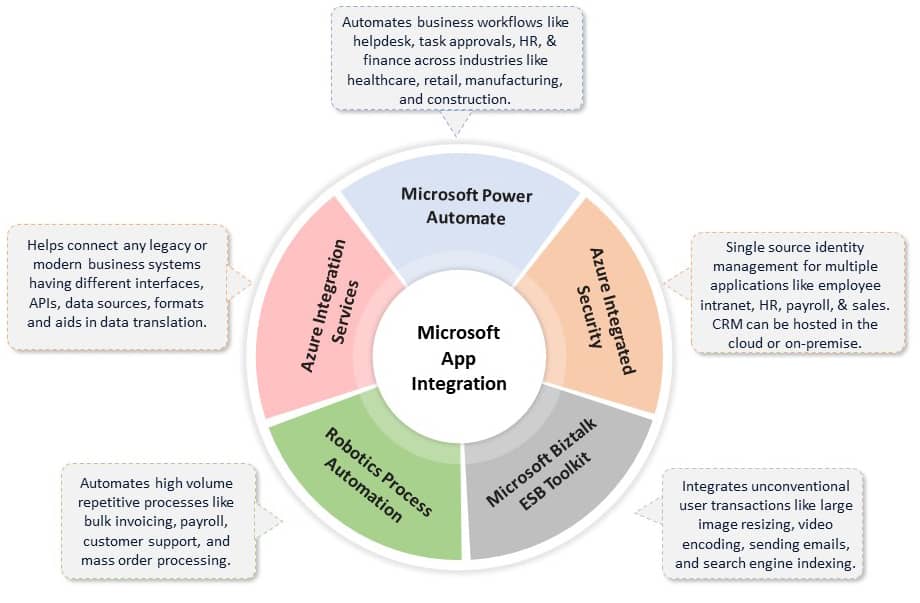
Microsoft offers several App Integration options to build solutions that connect applications and services on-premises and in the cloud.

  • Azure Integration Services enable scalable systems that can orchestrate business processes to connect On-Premise and cloud services using Service Bus, Logic Apps, API Management, and Event Grid.
  • Power Automate (earlier MS Flow) is a service-level offering that can be used to build codeless workflows to integrate business processes using hundreds of inbuilt connectors with disparate M365-based or marketplace applications.
  • Robotics Process Automation through the Power Automate platform using UI Flows builds end-to-end business process automation solutions. Coupled with AI-enabled Power Virtual Agents, it lets domain experts in your company create bots with a guided, no-code graphical interface to automate repetitive and manual efforts to improve productivity.
  • Azure Integrated Security powered by Azure Active Directory and Microsoft Graph allows seamless security integration among users in an organization and all tools and services hosted in Cloud or On-Premise. Features likes Azure B2B and Azure B2C helps extend application access capabilities and controlled permission management to vendors and partners outside the organization.
  • Microsoft BizTalk ESB Toolkit provides the capabilities to build message-based enterprise applications using a collection of tools and libraries that extend BizTalk Server’s capabilities of supporting dynamic messaging architecture to enable rapid mediation between services and their consumers.

App Integration Use Cases

Vertex App Integration

Why Vertex?

As a Gold Certified Microsoft Application Integration Partner, we have certified resources ready to go on all these empowering technologies. Vertex can help you evaluate your integration landscape and cloud integration strategy and build a migration path. Microsoft has recognized our expertise in the areas of Application Integration and Enterprise Business Process Automation.

Using Salesforce to Drive your Manufacturing Growth

You may already think of Salesforce as a powerful Customer Relationship Manager (CRM) application, but it can also help manufacturers to identify, prospect and track opportunities, customers, and cases to drive revenue and growth opportunities. Manufacturers who take advantage of the full breadth of Salesforce’s functionality realize improved revenues and growth margins – all while lowering their SG&A and Operations Costs.

How Can You Improve Your Revenue?

Vertex Computer Systems has helped manufacturers conduct B2B marketing campaigns that expand their ability to understand and respect their customers and ultimately contribute to the continued success of those valued partners. Similarly, Salesforce Sales Cloud can be utilized to attract and engage new customers before, during, and after the sale. If you’re serious about keeping track of your customers at every stage, Vertex has the Salesforce expertise to help you leverage customer relationships to grow sales and improve customer satisfaction.

Because Salesforce provides a true 360° view of the customer, manufacturers can get a clearer understanding of customer needs as well as their journeys through the sales process. Would you like to shorten the cycle from prospect to sale? Salesforce provides standard and custom pricing solution options to help manufacturers accelerate deals. The Partner Portal’s Community Cloud can also enhance collaboration with a manufacturer’s business partners for greater efficiency.

Key Salesforce Features That Help Manufacturers Grow Sales Revenue

  • B2B marketing campaigns
  • Lead scoring and automated assignments
  • Lead-to-Cash process optimization
  • Custom pricing solutions to accelerate deals and maximize gross margins
  • Partner Portal access via Partner Community for maximum collaboration
  • Streamlined/automated customer service experience
  • True 360° view of the customer providing revenues, returns, support costs, et al

The other side of the profitability equation involves the standardization, optimization, and automation of processes. If you’re interested in lowering your SG&A and operations costs, Salesforce can help. Did you know you can eliminate manual spreadsheets, replacing them with real-time processing, reporting, and alerts? Salesforce provides your Manufacturing team instant access to the same up-to-date detailed information. That’s just one way of many that Salesforce enhances operations.

Key Salesforce Features That lower SG&A and Operations Costs

  • Eliminating manual spreadsheets with real-time processing, reporting, and alerts
  • Demand Forecasting – both revenues and units
  • Contract management
  • Simplified order processing/ERP integration
  • MS Outlook/Gmail integration
  • Reduced customer service and support costs
  • Integrated, automated, and streamlined credit checking

If you want to leverage Salesforce to quickly move the needle for your manufacturing firm, give Vertex a call. You won’t be disappointed.

loader
Vertex Computer Systems is Hiring!Join the Team »
+