Accelerating Digital Transformation with Modern Integration Strategies: APIs, Microservices, and Beyond

We all talked about how the future will have everything from flying cars to AI-enabled homes, smart devices, and businesses. Well, the flying cars are still in beta phase, but everything else is here. The most prevailing of which is the digital transformation of businesses and organizations.

It is no longer a distant thought but a reality, and the entire world is hopping on this, so what are you doing to stay on top of everyone else? With everyone having access to the best of services, the difference comes from how you implement that service and get the desired results. This is where the modern integration strategies come into play; these are backed by APIs and microservices.

They also use a lot of AI-enabled architectural patterns; this is the new face of digital transformation.

The Integration Imperative: Why Traditional Approaches Fall Short

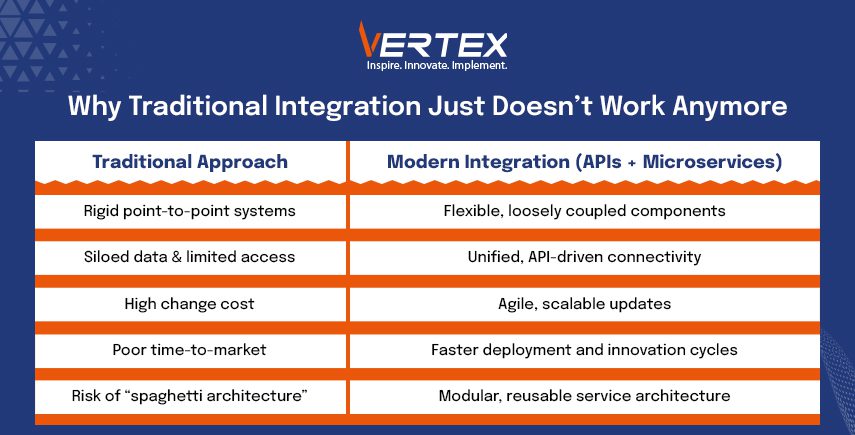
The traditional integration methods are functional, no doubt, but they rely on outdated methods and technologies. They use point-to-point connections, which are rigid, slow, and prone to “spaghetti architecture.” When any business integrates an array of cloud services or SaaS applications, this rigidity will hamper the integration and result in issues. We have discussed some of these issues below for better understanding.

  • Siloed Data: Most of the time, a lot of information gets trapped in different systems, preventing a complete view of the customers, operations, and performance.
  • Slow Innovation: If we make changes in a coupled system arrangement, then the probability of ripple effects skyrockets. Making rapid deployment nearly impossible.
  • High Costs: If we have to do complex and custom changes and integrations, then that will cost more and deplete resources.
  • Lack of Agility: Businesses are slow to respond to new trends, and they are rigid in their methods. Customer demands change with time, and if the business is not flexible with them, then it can face a lot of queries from customers.

According to a report done by Veritas, the digital transformation market is set to experience substantial growth, with a projected CAGR of 22% between 2021 and 2025, reaching a market value of USD 3.7 trillion. This report is a wake-up call on the urgency of the situation and the need of impactful integration strategies, so that businesses can capture the market with the full potential of digitalization.
APIs: The Foundation of Modern Connectivity

APIs or Application Programming Interfaces are the reason why modern software can interact with each other without diving into the internal complexities. APIs are standard contracts between these software, which make sure that there is no peeking behind the curtain and no unethical data leaks. APIs are more than technical enablers; they are responsible for creating an ecosystem of digital software. This generates a lot of revenue, according to a coverage done by PR News, the API management market is projected to expand from $4.5 billion in 2022 to $13.7 billion by 2027, growing at a compound annual growth rate (CAGR) of 25.1%.

How APIs Accelerate Digital Transformation:

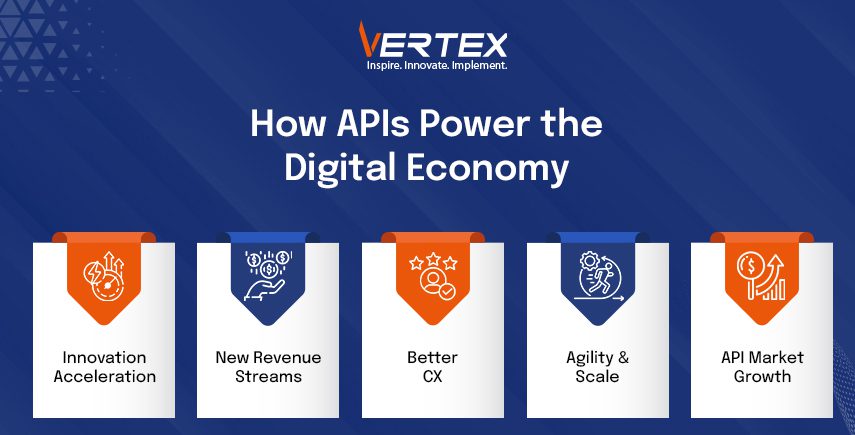
APIs are the catalyst that is accelerating Digital transformation, and we have discussed some ways in which APIs are pushing for the growth of Digital Transformation.

  • Innovation Acceleration: APIs can help by exposing functionalities, which in turn can help teams, partners, and developers build applications. This promotes a culture of collaboration and creation. Companies like Google and Amazon offer API services, such as Google Maps APIs, so that developers can use them to build a large ecosystem of apps.
  • New Revenue Streams: With the help of API services, companies have been able to develop an entirely new source of income. As they allow businesses to monetize their own data and services by offering APIs. For example, OpenAI also offers API access and earns a “API Economy,” which allows businesses to monetize their data and services by offering API access.
  • Enhanced Customer Experience: APIs have helped develop some of the best personalized customer experiences. The best example is banking apps, which use Banking APIs and then connect banks with payment portals and merchants, enabling one of the top-notch financial data and payment exchanges.
  • Agility and Scalability: APIs provide a lot of agility and independence, they promote loose coupling, which entails that changes to one service will not affect any other services. This also , makes the development and deployment of services and apps much faster.
Microservices: Deconstructing the Monolith for Greater Agility

Microservices is the reason why businesses are able to create and deploy their services much faster using APIs. Microservices break down the monolithic application into small, independent, and loosely coupled services. Each of these coupled services generally takes care of one business capability and communicates with other services using APIs. This also allows for more innovation in a limited time.

Benefits of Microservices for Digital Transformation:

  • Independent Development and Deployment: One of the perks of microservices is that teams are capable of developing, testing, and deploying their own microservices. This reduces dependencies and expedites the entire process.
  • Scalability and Resilience: This particular trait of microservices is my favorite. if there is any issues with a single microservice then, it will not harm other microservices in any way and will not affect the workflow as well.
  • Technology Heterogeneity: Microservices allow the flexibility to use different programming languages, databases, and technologies for each service, rather than being confined to a single tech stack.
  • Improved Fault Isolation: As discussed earlier, the loosely coupled nature of microservices safeguards them from errors or failures.
  • Easier Maintenance: Smaller codebases are much easier to understand and maintain. Furthermore, they are also easier to debug and decode, and help in reducing technical debt. Some of the famous companies that use microservices are Netflix and Amazon. They leverage microservices to deliver innovation and the best customer experience.

Beyond APIs and Microservices: Advanced Integration Strategies

Adding advanced integration strategies helps by boosting the entire framework and add another layer of technological edge to the entire system.

Event-Driven Architecture (EDA): Real-time Responsiveness

Real-time insights are crucial, and they are the one factor that creates differences in terms of profit. Reacting to trends and market shifts, real-time is what gives any business its edge. Event-Driven Architecture, or EDA, is an integration pattern in which systems communicate by publishing, capturing, processing, and reacting to events.

Advantages of EDA in Digital Transformation:

  • EDA makes real-time processing of data possible, along with real-time analytics, faster decision making, and even lets you automate responses for critical scenarios.
  • EDA also promotes loose coupling, in fact it kicks it up a notch and allows services to scale independently and respond to demand spikes if any.
  • There are audit logs of events, in case there are errors, and there is also a secondary recovery mechanism.
  • EDA can be integrated with legacy systems, microservices, and external cloud services, and it does that irrespective of their underlying technologies.

Low-Code/No-Code Integration Platforms: Democratizing Connectivity

Since the demand for digital solutions is through the roof, and there are not that many skilled technical experts. Use  Low-code/no-code (LCNC), these integration platforms provide a drag-and-drop interface that enables non-technical workers and business users to build integrations and applications with minimal or no coding at all. This is also proven true by the increased demand for the LCNC in the market.  According to a report done by Proficient Market Insights, the global Low-code and No-code Platform Market is poised for significant growth, projected to reach USD 256.45 billion by 2033, with a CAGR of 25.9% from 2025 to 2033.

Impact of LCNC on Digital Transformation:

  • LCNC platforms cut down on the time and effort usually required to build integrations and applications.
  • They enable normal businessmen and non-technical workers to build integrations and applications with ease.
  • LCNC makes the work of the IT department easier with their drag-and-drop interface, so even business users can handle simple integration tasks.
  • Businesses can quickly adapt to the changing requirements by making prototypes and deploying those integrations.

The Road Ahead: Best Practices for Successful Integration

Digital transformation is a multi-step process, and when we mix microservices and APIs along with technical integrations, the entire process becomes more complex. We have discussed some of the best strategies businesses can use to benefit.

  • Develop a Comprehensive API Strategy: Go with an API strategy that encompasses public, private, and partner APIs, along with proper documentation.
  • Embrace a Product-Centric Approach to Microservices: Microservices should be used and treated like a product of their own and should have their own team, ownership, and boundaries.
  • Invest in Robust Integration Platforms: You can use Integration Platform as a Service (iPaaS) solutions or other enterprise integration platforms that offer capabilities for API management.
  • Prioritize Security from the Outset: Ensure you implement a zero-trust architecture, as more integration points introduce more potential vulnerabilities. Additionally, continuously monitor to safeguard data and integration touchpoints.
  • Foster a Culture of Collaboration: Take down the boundaries of teams, operations, and businesses. Both DevOps and GitOps are crucial for a streamlined development and deployment cycle.

Conclusion

Digital transformation with modern integration techniques is a great way to streamline your business, offer new services to customers, and generate new revenue streams. In this article, we learned that not only can digital tools help a business grow, but without a dedicated framework consisting of Microservices and APIs, the end goal is tough to reach.

Furthermore, the use of advanced tools like EDA and AI/ML will enable your business to get cutting-edge technology and move beyond digitalization, and transform into a dynamic digital landscape.

So if you wish to incorporate all this digital arsenal into your business and do not know where to start, then connect with experts at VertexCS and we will help you transform

Zero Defects Code: Vertex Launches Custom
Project Management Solution for a Fortune 50 Customer

Each profession has its state of nirvana (eternal bliss). A baseball pitcher’s nirvana is throwing a perfect game, not allowing a single opposing batter to get on base. A cricket bowler’s is getting a hat trick – three outs in three consecutive balls. These feats are rare, so when they’re attained, they are celebrated.

Software developers also have a state of nirvana. That is producing zero-defect code. As in baseball and cricket, this feat is seldom achieved. Even the titans of our industry – Microsoft, Google, Apple, IBM – talk about zero-defect code as a holy grail they only dream of.

Vertex recently achieved this holy grail by developing a zero-defect software system for a custom application we developed for a Fortune 50 US-based enterprise. Our feat is even more satisfying because we were able to produce high-quality software for a highly complex business problem for which the customer had only a strawman of what they wanted to do and had no specific requirements.

This is a story of how the talented Vertex team achieved a feat that few have done in our industry.

The Customer and the Problem Statement

For confidentiality reasons, the customer cannot be named, but to set the context, let me just say that they are a Fortune 50 CPG company with over 80 brands operating in most of the global regions. Most products and brands are sold worldwide, with some variance for regional demographics and preferences. Product launches (called initiatives) are a big deal with the customer; it takes bringing together globally distributed teams to plan, design, and execute product launches.

When a new initiative is launched, there are usually around 1,000 collaborators spread across several world regions, and functional roles and technical expertise that come together to gate the decisions that need to be made to keep steady and timely progress. The customer had no effective tool to capture, communicate, track, and keep up with such a humongous undertaking.

This is where we entered and built a custom solution.

Diagram


Building the Vision and Evolving Through Discovery

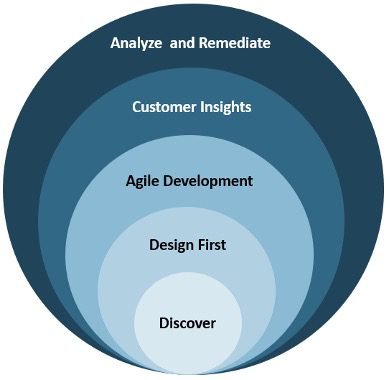
All engineering projects are guided by a few basic principles. When you build a ship, you start by designing the hull of the ship. When you build a house, you start with building the foundation. Software development projects, like other engineering disciplines, should start with defining the requirements of the solution. In our situation, the customer only knew about the problem that they wanted to solve. They did not have a vision of what a solution would look like. We used the requirements gathering stage to define the key problem statements and build a vision of what the solution should do. We spent about 30% of the entire duration on the requirements definition. This helped us to align with the customer to build a holistic scope of the system. The requirements document thoroughly defined the project boundaries and were built iteratively with customer’s inputs.

Design First

In a trade school, carpenters are taught to measure twice and cut once. In software engineering, it should be first design, then build. Our approach was thorough and detailed. We were launching the project for the Initiatives team of just one product category. Our customer had told us that if the solution was successful, they were going to open it up for all categories. We knew that our design had to accommodate changes in the future.

Data Model Design: The primary goal of the data model was to keep the database lean with lesser objects, denormalized to reduce network latency and the number of calls. We avoided direct relations in tables, limited applying constraints, and eliminated all kinds of cascading operations to reduce over-dependency on the database. All kinds of database programming were eliminated. Constraints and on-demand relations were controlled from the program’s entity framework model to allow more flexibility to the overall design.


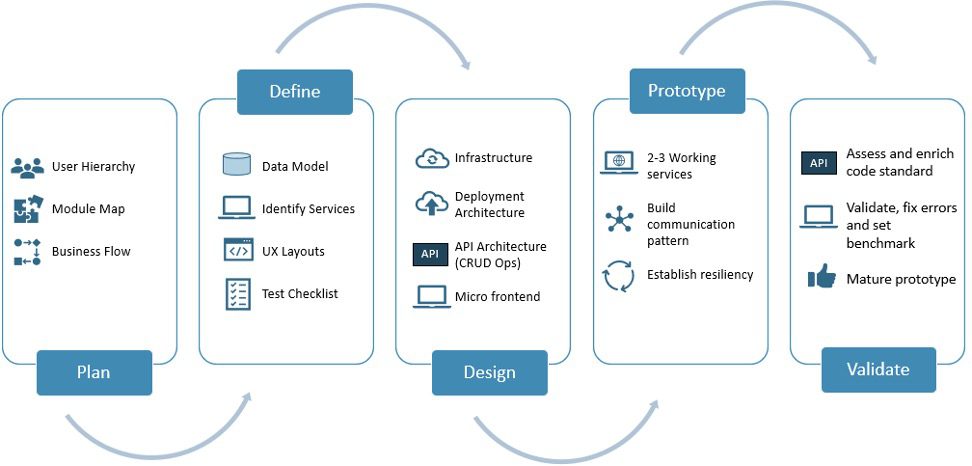
Application/API Design: The application design went through phased stages (refer to diagram), something we did not try before. The principle was to establish a working prototype or template solution using few modules (as API or services). Once the prototype was tested and benchmarked the team was ready for continuous programming for the rest of the application building and focus on the functional aspects. The primary concept of API architecture was to identify services from business contexts, define micro-modules adhering to the core principles of microservices, build communication patterns between modules and yet develop it for a single Cloud Platform-As-A-Service (PAAS) solution. Each module represented a business functionality in the product and was designed to work independently. 90% of the system was designed to be Administrator controlled, hence a loosely coupled service-based architecture was the need.

Our Approach

Our Approach

We saved time by reducing a large upfront effort on mockup or wireframe by sharing an outline of the UX using PowerPoint and engaged with the customer in designing the system flow. This provided more touchpoints with the customer during the design stage, helping them visualize their system before it was built.

Agile Development

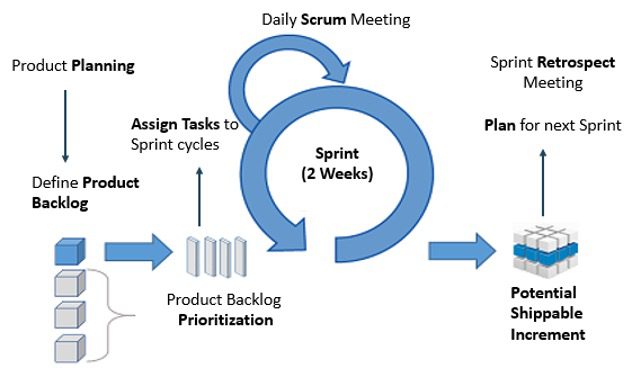
Before development started, the development team was fully immersed in the requirements document, which gave them the roadmap for the entire system. We adopted an agile development approach, with sprint cycles defined well in advance with tasks to be achieved. Each sprint consisted of 10 days. The building principle was to develop fast, fail fast, and recover fast. For each sprint cycle, we dedicated 75% of the time for development, 15% for integration testing, and 10% for issue fixing before turning it over to the users as a beta release. The development team was engaged in daily scrum calls, beyond other technical brainstorming sessions to reduce understanding gaps. Communication helped in reducing friction between modules built by multiple developers to ensure smoother integration. This ensured that each sprint cycle was defect-free and the users were asked to just validate the system. We presumed that about 20% of the requirements would change as we were building the system. Our agile method and our modular design approach gave us the flexibility to accommodate these changes without introducing defects.

Our Approach

Picture

Customer Insights

We kept engaging with the customer closely during the construction stage to exchange thoughts and demonstrate the continuous progress of the product. Wherever certain things were either technically not feasible or contradicted good design principles, we logically explained the reasons and adjusted our design accordingly. The customer was assured of the best design principles being adopted at every stage of the build. Using agile development principles helped in including our customer’s thoughts and adopting late changes in the product lifecycle easily. Including customer insights at key stages of the development helped us reach a high level of customer satisfaction at the end.

Analyze and Remediate

A key component towards a zero-defect journey was to predict defects before they arose. Our vast experience in custom development helped us to conceive a checklist of potential defects from a typical web development process. Developers treated the checkpoints as part of their development process, thus strengthening the unit testing practice. Quality software checks included performance checks and negative validation. Fixed issues which impacted core design were repeatedly checked after every sprint to ensure the particular functional area was not impacted due to other changes.

It is Not UAT Anymore, but UVA

Most custom software falls into the trap of a User Acceptance Test (UAT) stage. We did not want the user to test; we wanted them to validate the function. We started by calling the stage UVA – User Validation and Acceptance. This name change shifted the mindset of the developers and users. The users came into this stage with the mindset that they were being provided a functioning system and they just had to validate that the functions existed.

Yes, Zero-Defect Code is Possible

Custom software development often scares organizations. They are unsure of what needs to be built, how it should be built, and whether they will get what they want.  Our journey proved that with the right approach, we can build software that will deliver with zero defects. Our journey is repeatable. It is just a matter of discipline.

Enterprise IT Transformation with Microsoft

Application Integration for Digital Transformation

Application Integration is the process of enabling different digital applications – each developed for a specific purpose – to work with each other. When configured properly, integration allows distinct systems to seamlessly communicate.

In today’s world, Enterprise IT Transformation invariably includes leveraging the Cloud.  As organizations re-engineer their business processes, leveraging On-Premise systems and investments that are already in place and integrating them with new cloud-based solutions is key to cost-effectively stand up new capabilities and services.

Cloud-based app integration is pivotal in business process augmentation, involving various tools and technologies. With clear planning, app integration can reduce IT silos and improve connectivity to integrate applications that unify management, ease access, and limit manual intervention by utilizing various ready-to-plug-in Microsoft Azure Cloud tools and services.

Microsoft offers several App Integration options to build solutions that connect applications and services on-premises and in the cloud.

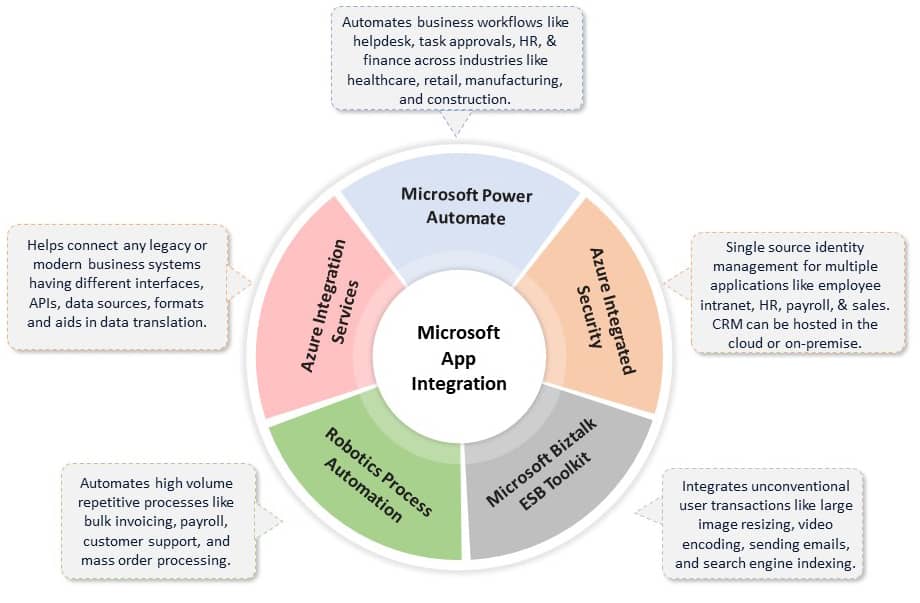
  • Azure Integration Services enable scalable systems that can orchestrate business processes to connect On-Premise and cloud services using Service Bus, Logic Apps, API Management, and Event Grid.
  • Power Automate (earlier MS Flow) is a service-level offering that can be used to build codeless workflows to integrate business processes using hundreds of inbuilt connectors with disparate M365-based or marketplace applications.
  • Robotics Process Automation through the Power Automate platform using UI Flows builds end-to-end business process automation solutions. Coupled with AI-enabled Power Virtual Agents, it lets domain experts in your company create bots with a guided, no-code graphical interface to automate repetitive and manual efforts to improve productivity.
  • Azure Integrated Security powered by Azure Active Directory and Microsoft Graph allows seamless security integration among users in an organization and all tools and services hosted in Cloud or On-Premise. Features likes Azure B2B and Azure B2C helps extend application access capabilities and controlled permission management to vendors and partners outside the organization.
  • Microsoft BizTalk ESB Toolkit provides the capabilities to build message-based enterprise applications using a collection of tools and libraries that extend BizTalk Server’s capabilities of supporting dynamic messaging architecture to enable rapid mediation between services and their consumers.

App Integration Use Cases

Vertex App Integration

Why Vertex?

As a Gold Certified Microsoft Application Integration Partner, we have certified resources ready to go on all these empowering technologies. Vertex can help you evaluate your integration landscape and cloud integration strategy and build a migration path. Microsoft has recognized our expertise in the areas of Application Integration and Enterprise Business Process Automation.

loader
Vertex Computer Systems is Hiring!Join the Team »
+